Have Questions?
We'll review your message and get back to you within 48 hours.
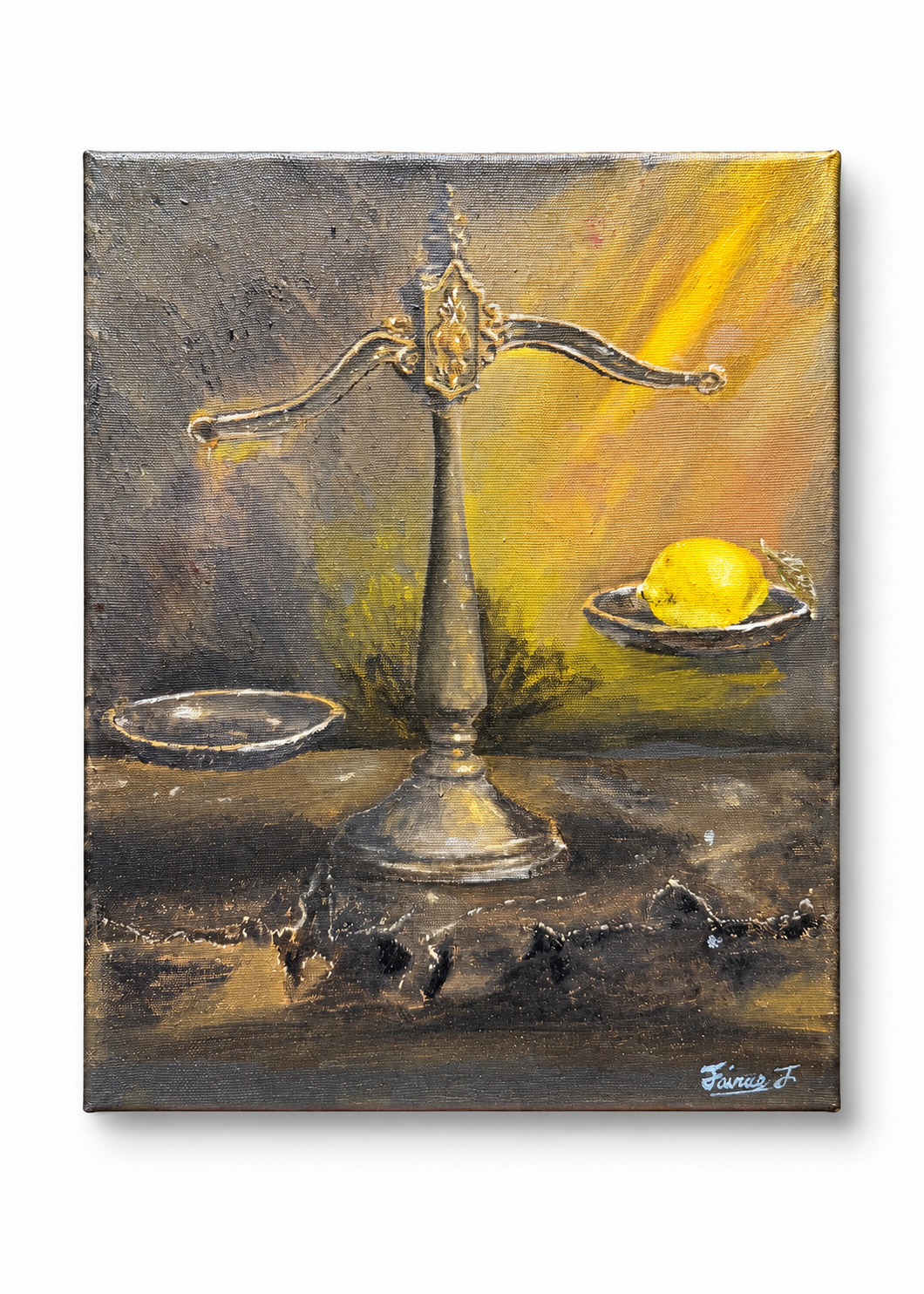
Even emptiness can carry weight.
In Rhythm, a lemon represents self-control, resting on one side of a scale while the empty plate hangs lower. What appears to hold nothing carries the greater weight. A thought provoker to help us see what could be creating the imbalance in our lives that we need to control.
As the scales swing back and forth, the goal is to find a rhythm within the season we are living. Life does not always allow everything to balance evenly. Through self-control and moderation, we learn when to give more, when to pull back, and where our attention is needed.
Part of the Fruits of the Spirit collection, Rhythm asks us to consider what belongs in that empty space.
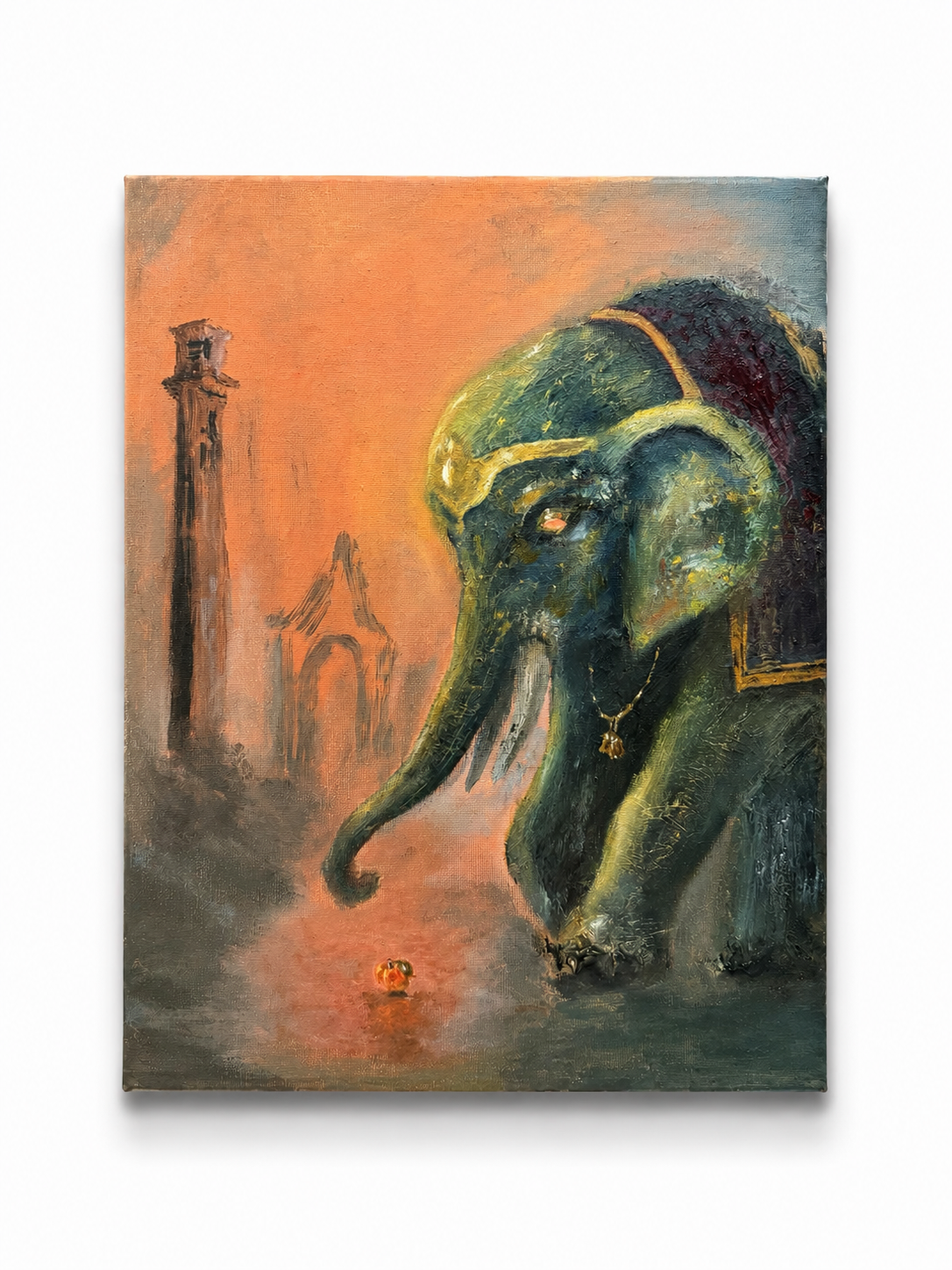
True gentleness begins with the freedom to choose how we use our strength.
In Liberty, an elephant draped in gold and South Asian–inspired ceremonial majesty, encounters a small peach in a landscape alive with supernatural energy. It lowers its trunk to inspect the delicate fruit, pausing to appreciate what it could so easily crush. Its authority is revealed in its restraint, giving the peach room to exist untouched.
Part of the Fruits of the Spirit collection, Liberty explores gentleness as the freedom to possess great power and choose tenderness. The elephant governs its own strength, allowing something fragile to remain whole in its presence.
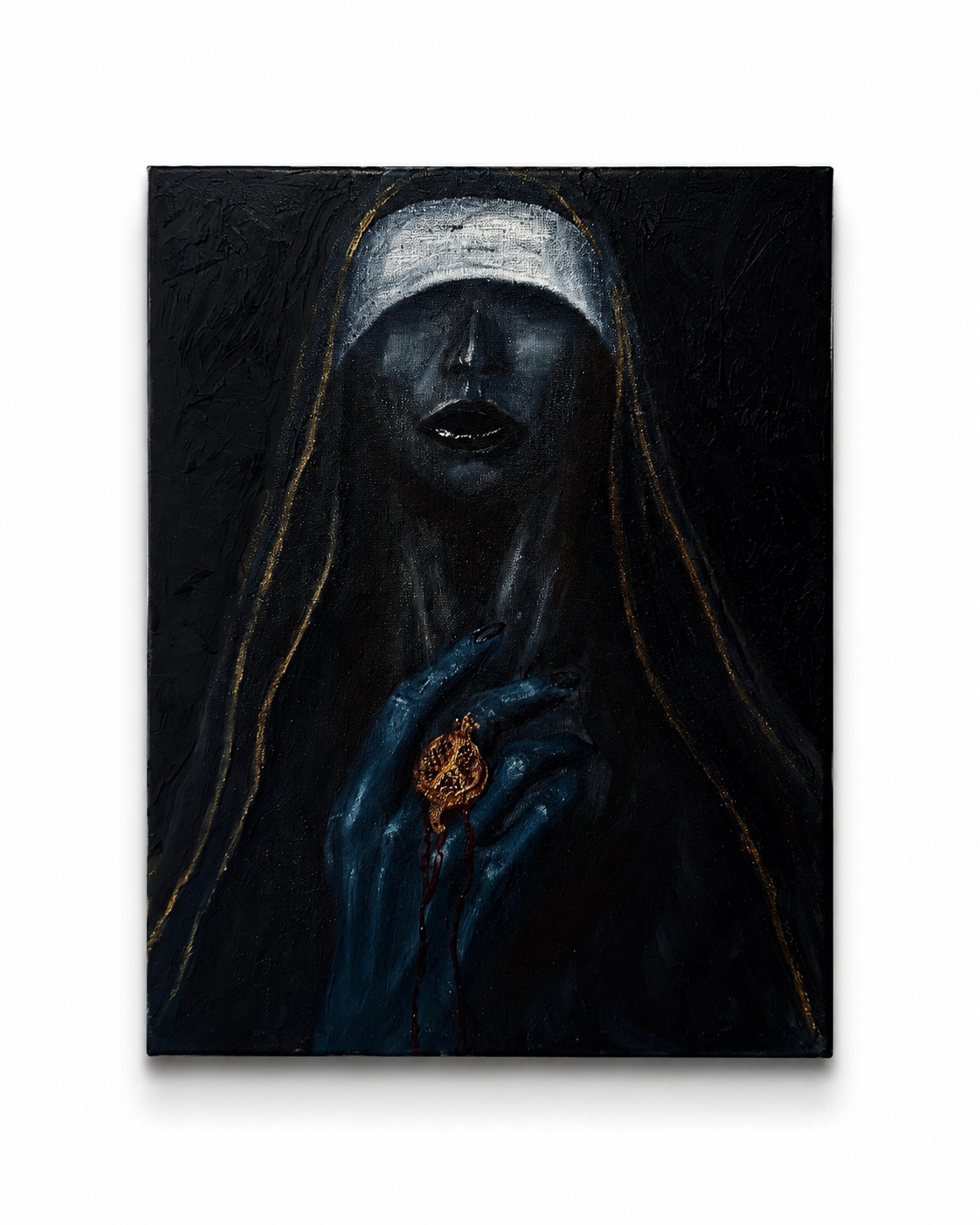
She cannot see what lies ahead, yet her promise remains.
In Her, a nun without eyes stands enveloped in darkness, her hand held against her heart. A golden pomegranate ring tightens against her flesh, drawing blood that symbolically seals a covenant of faith. The ring carries the weight of her vows: a promise made once, then lived through every season of uncertainty.
Part of the Fruits of the Spirit collection, Her reflects on the devotion that keeps faith alive when reassurance is out of sight. Though she cannot see the way forward, she remembers whom she has entrusted herself to—and carries her promise into the darkness.
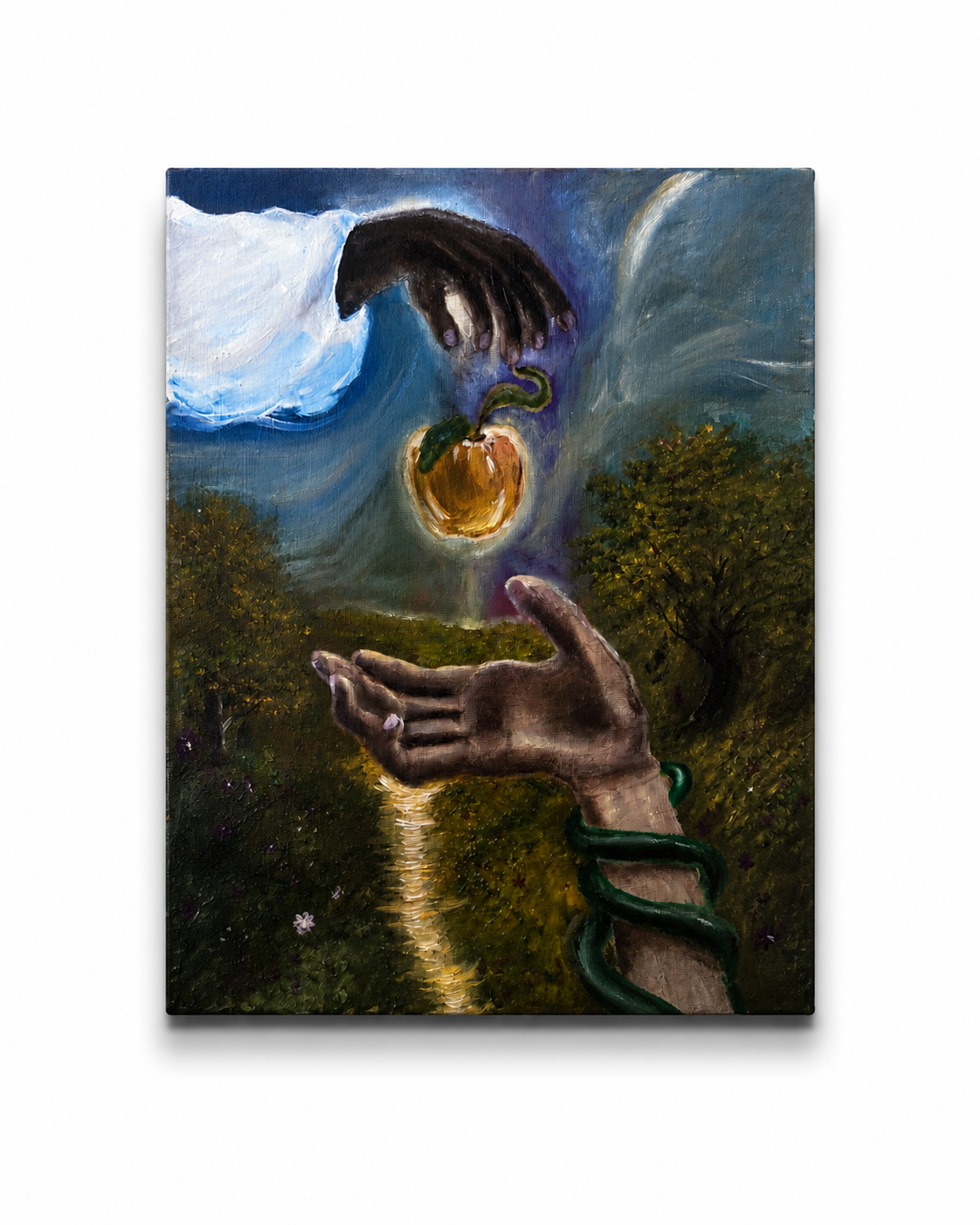
Before the first bite, there was an exchange.
In The Exchange, two hands reach toward a golden apple, reimagining Eden’s forbidden fruit as a transaction between goodness and evil. A serpent coils around one wrist as the fruit hangs between offering and receiving.
A moment where desire meets consequence.
Part of the Fruits of the Spirit collection, this work asks us to examine our own exchanges: when we reach for what we want, do we recognize the goodness we may be letting go?
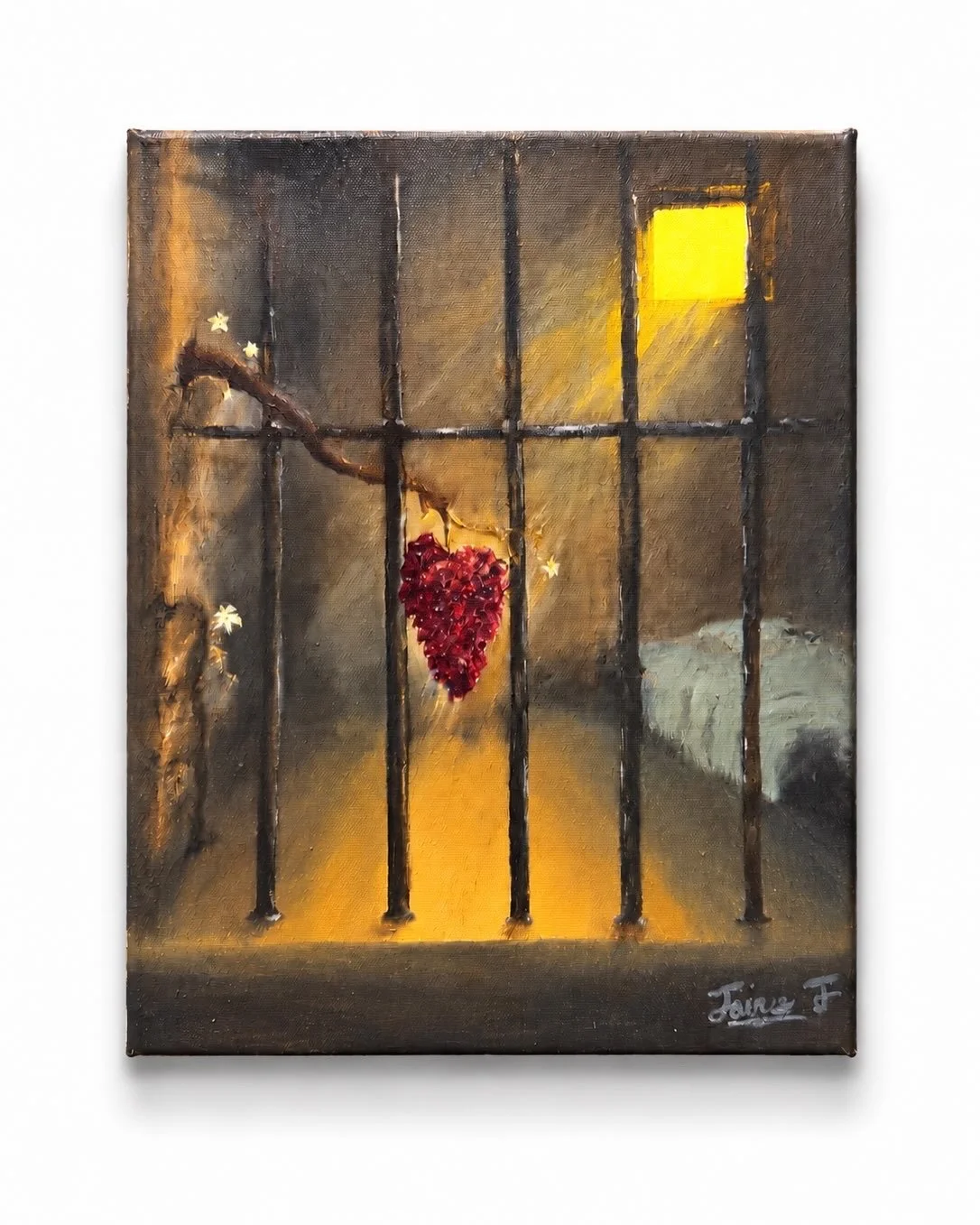
In Company, a grapevine crosses prison bars, offering sweetness in a place of isolation. Perhaps it reaches inward to nourish someone forgotten. Or perhaps the prisoner grew it himself, extending kindness from the very place he longs to escape.
The work echoes Paul’s letters from prison, carrying encouragement beyond the walls that confined him. Part of the Fruits of the Spirit collection, Company asks us to consider what we can still offer while enduring hardships of our own. Even here, something good can grow, and someone else can be nourished by it. Grapes being the easiest fruit to share.
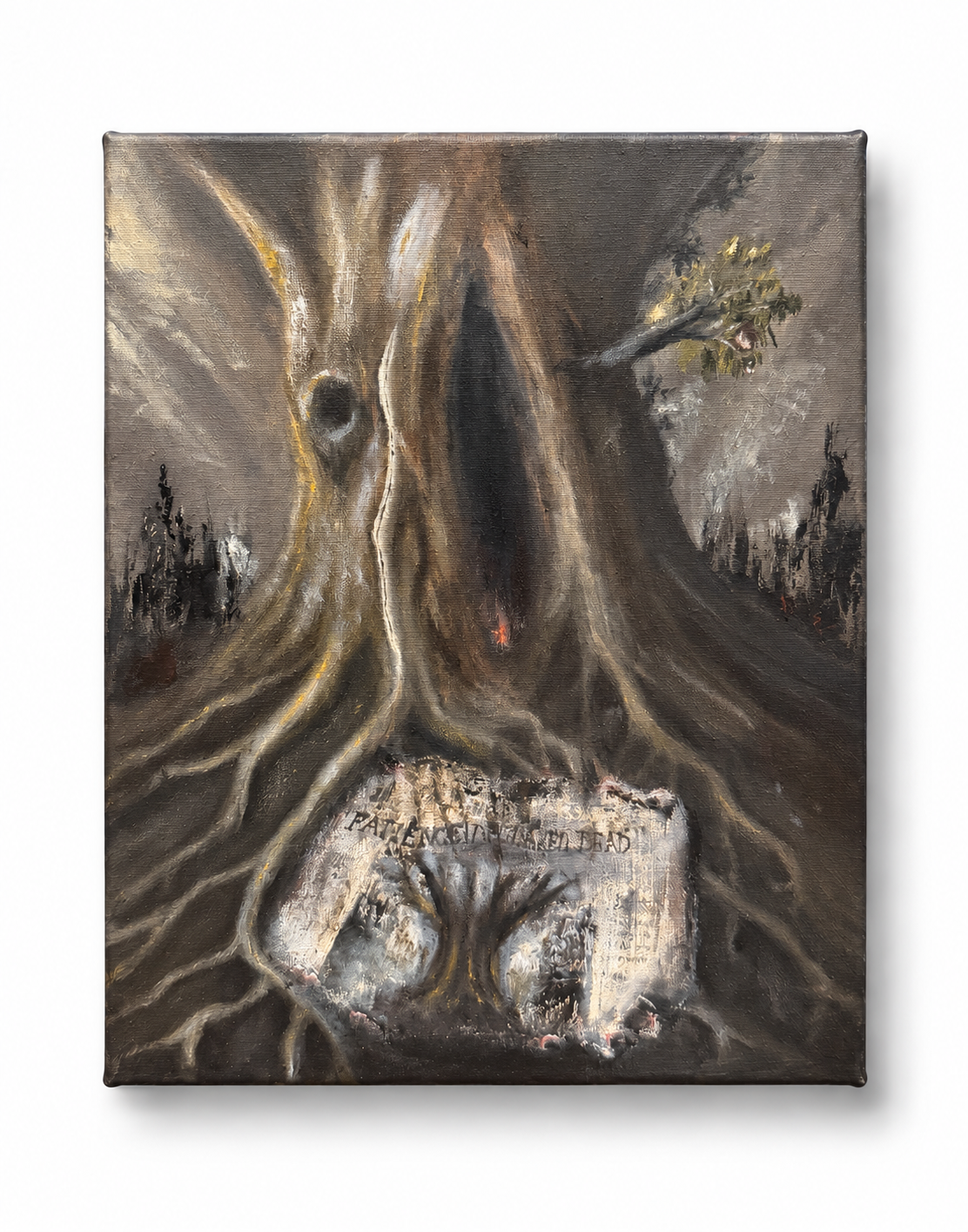
In Scar, a weathered fig tree stands with its wounds exposed. Its hollowed trunk and marked bark carry the history of what it has endured, while fruit quietly emerges from a surviving branch. At its roots, a burning newspaper declares patience dead, even as the tree above it continues to bear life.
The journey between planting and harvest can change us. We encounter loss, disappointment, and long stretches when the care we have given seems to produce nothing. We may begin to question what we planted years ago, forgetting that growth has been taking place beyond what we can see.
This painting holds the scars and the fruit together. Time has not erased every wound, yet the tree still has something to give. What was planted in an earlier season has matured into nourishment for the present—a reminder that the work of our past can bear fruit long after we expected it to.
As part of the Fruits of the Spirit collection, Scar reflects on patience as the faith to keep tending what God has entrusted to us. The harvest may find us weathered, carrying scars we never expected when we first planted the seed. Yet, in time, the tree we nurtured through seasons of uncertainty begins to bear fruit, offering sweetness from the very branches that still remember the storm.
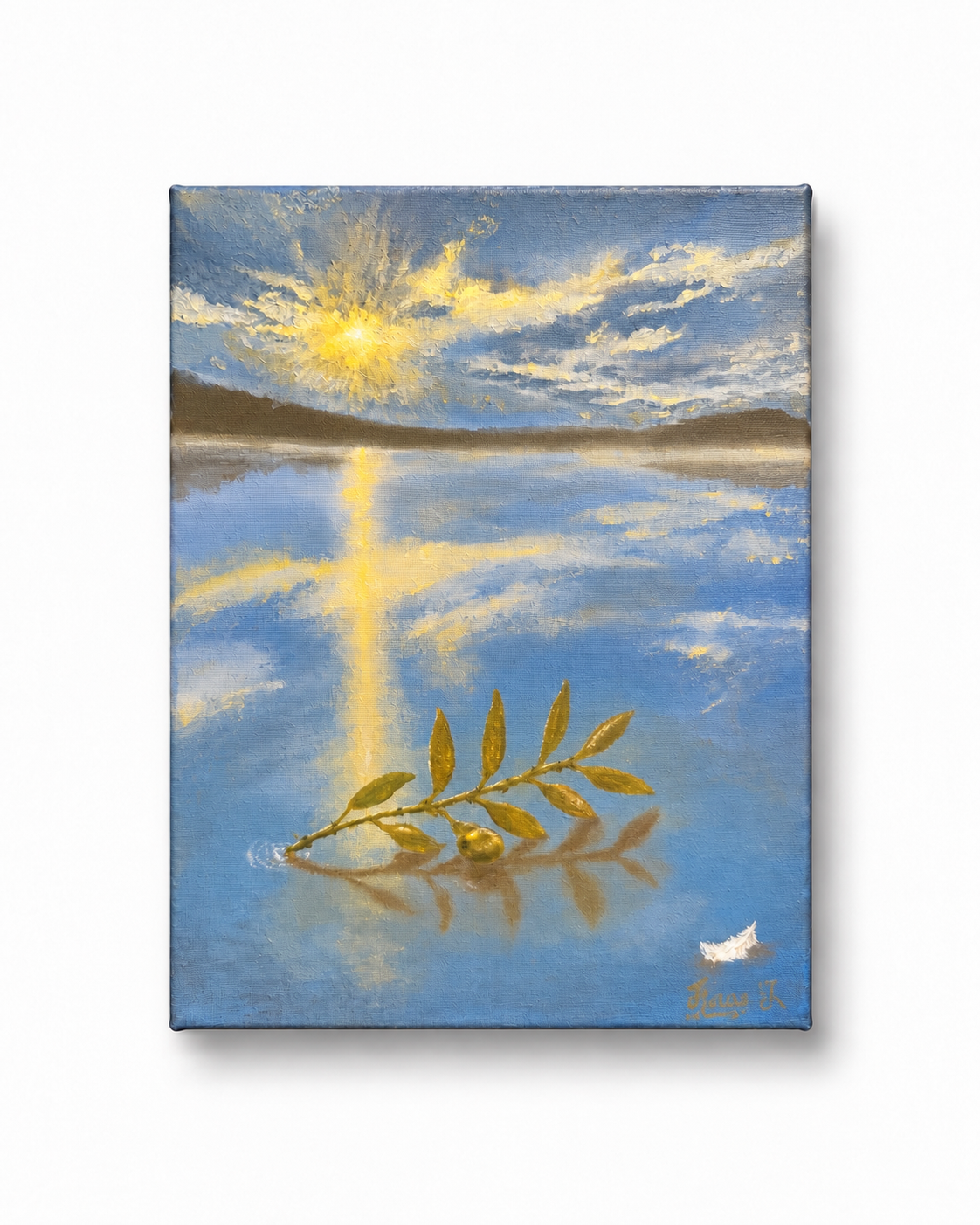
We recognize the olive branch as an offering of peace. But who is willing to extend it?
In The Messenger, an olive branch rests upon still water beneath a sky illuminated with gold. A single white feather hints at the presence of a dove, yet the messenger remains unseen. The offering is before us, leaving us to consider where it came from—and whose hands might carry it next.
It is easy to desire peace while waiting for someone else to make the first move. Extending it asks something of us: the humility to begin a difficult conversation, the courage to offer an apology, the willingness to meet another person with grace while our own hearts are still tender. Someone must choose to make peace a decision, with the efforts to deliver the olive branch as a messenger.
As part of the Fruits of the Spirit collection, this work reflects on the peace God offers us and our responsibility to carry it into the lives of others. The water becomes a place of reflection, inviting the viewer into the space the messenger has left open.
I used to expect joy to feel more exciting than it did.
My relationship with joy felt a little bland until I began to understand its quieter purpose. Sometimes joy is like nourishment when you’re feeling depleted: something you must continue receiving, even when the change is too gradual to notice.
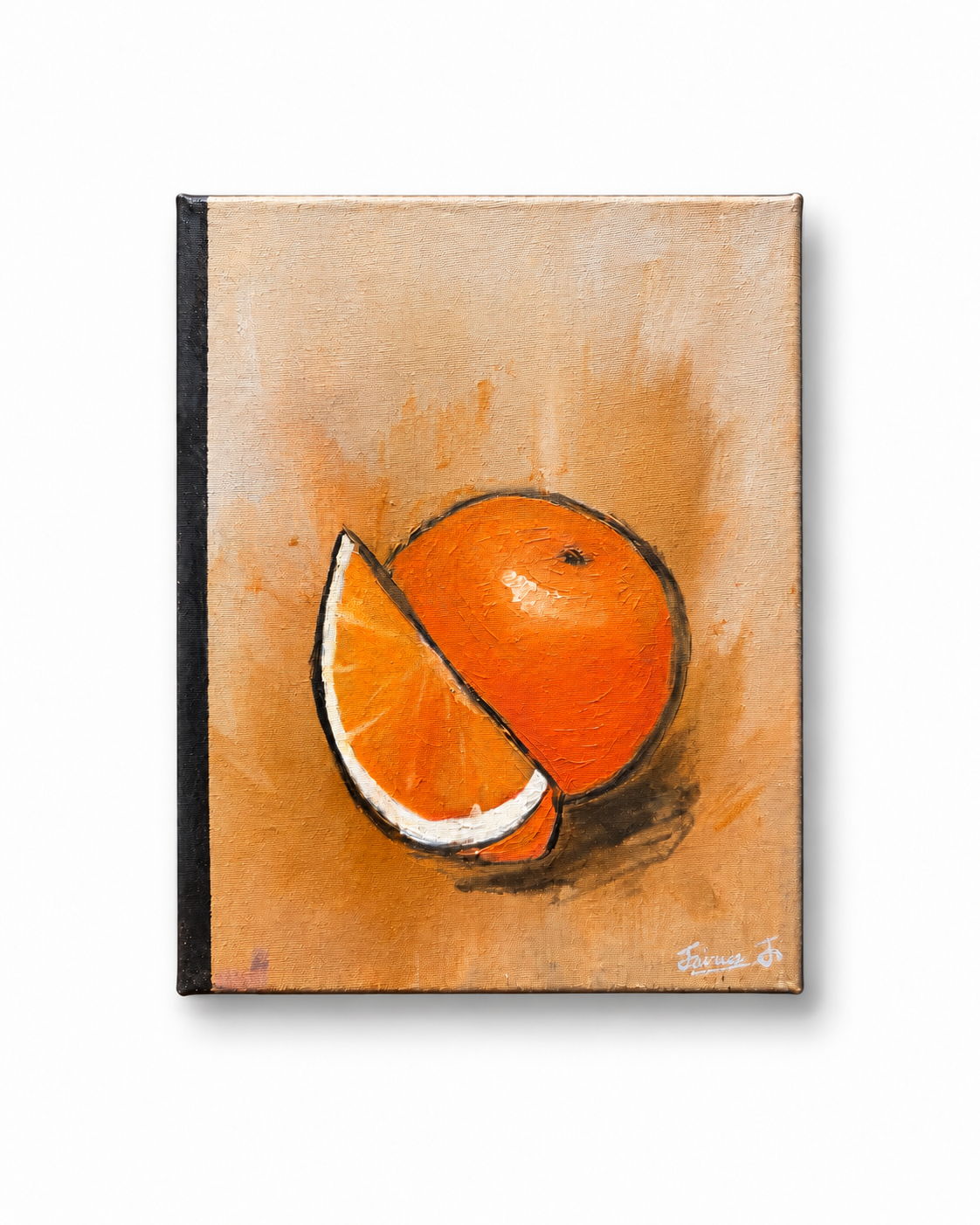
In The Fix, the orange represents that daily return. I think of it like reaching for vitamin C when I’m feeling sick, with the anticipation of feeling better. That is how I am learning to practice joy: making room for it, returning to what nourishes my spirit, and trusting that something is happening even when I cannot feel it immediately.
The simplicity of this painting is part of its meaning. I wanted to focus on the consistency and purpose of joy—the willingness to keep showing up without needing every moment to be exciting. In my own life, returning to joy has helped me find the strength to begin again, often quietly, often slowly.
Part of the Fruits of the Spirit collection, The Fix reflects on the anticipation of something good still ahead. Sometimes that anticipation is enough to move us—to do the work, to care for what is growing, and to keep going until we can see what we have been hoping for.
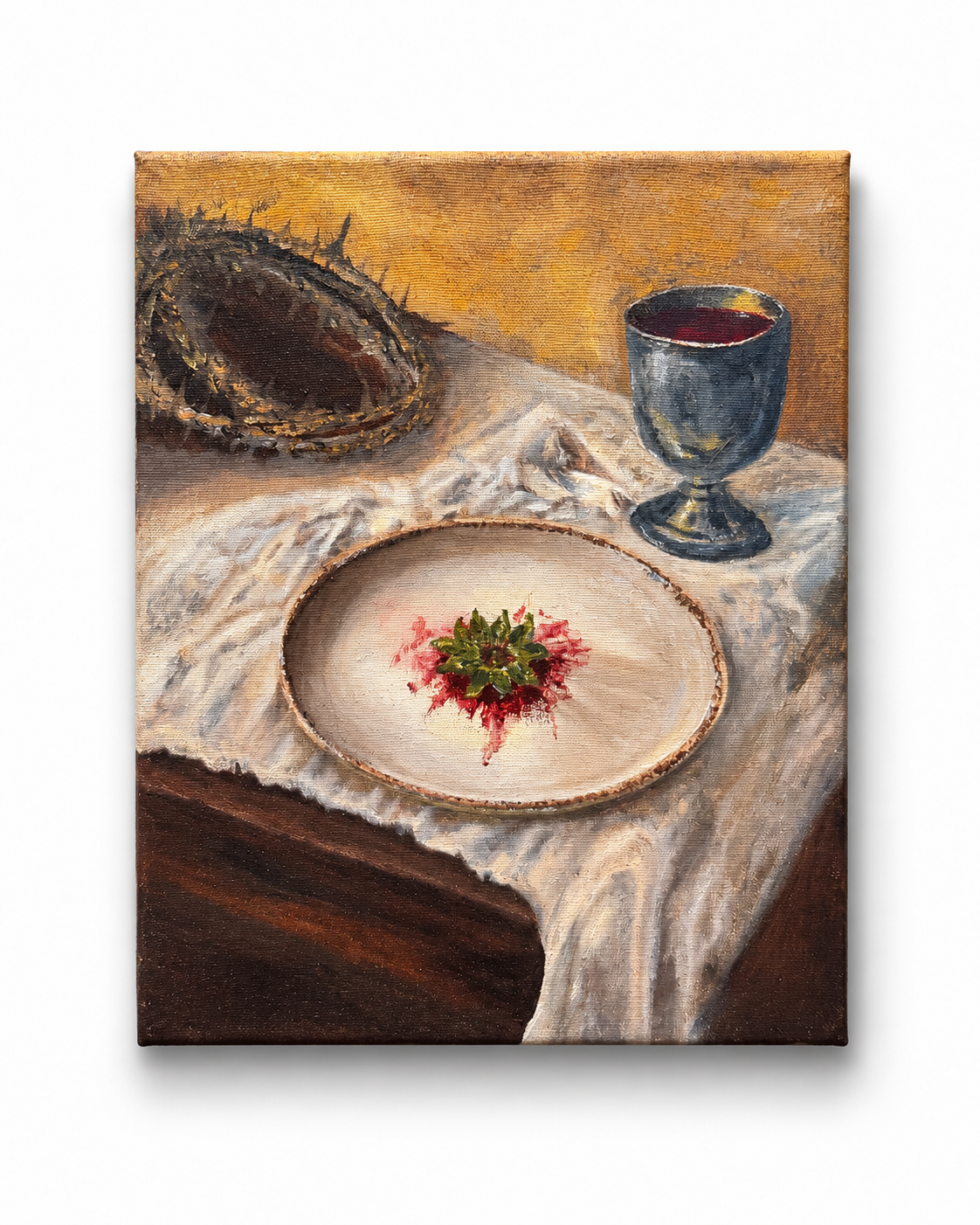
What remains on the plate tells the story of what was given.
In Take, Eat, the remnants of a strawberry rest beside a cup of wine and a crown of thorns. The fruit has been consumed, its red stain left behind—a reflection of love poured out so another might be nourished.
Drawing on the sacred imagery of communion, this painting contemplates Christ’s invitation to receive the love He offered through sacrifice. As the opening work in Fruits of the Spirit, it asks us to consider the cost of the love that sustains us—and how we might offer that love to others.
No results match your search. Try removing a few filters.
We'll review your message and get back to you within 48 hours.